
Azura may be a P&O fan‑favourite, but choose the wrong stateroom and you’ll spend your cruise hearing pool pumps, buffet trolleys or engines instead of steel‑band melodies.
This guide pinpoints the noisiest, roughest and most obstructed cabins for 2025 sailings—plus proven tricks for snagging the perfect retreat.
Methodology & Sources
How We Gathered Feedback
- Cruise Critic threads: scanned every post that named a specific Azura cabin and described noise, motion, or view problems.
- Facebook cruise groups: keyword‑searched posts for “Azura + noise / vibration / motion” and followed up with posters who named cabins.
- Reddit communities (r/Cruise & r/PandOCruises): filtered by recent trip reports and questions, focusing on 2024–25 sailings.
- Official deck plans (post‑2023 refit): cross‑checked every anecdote to confirm the venue or machinery still sits directly above, below, or beside the cabin in question.
- Consistency test: a cabin made the “avoid” list only if at least two unrelated cruisers reported the same issue or the physical layout clearly predicts trouble (e.g., lifeboat mechanisms).
Why Azura’s Deck Layout Matters After the 2023 Refit
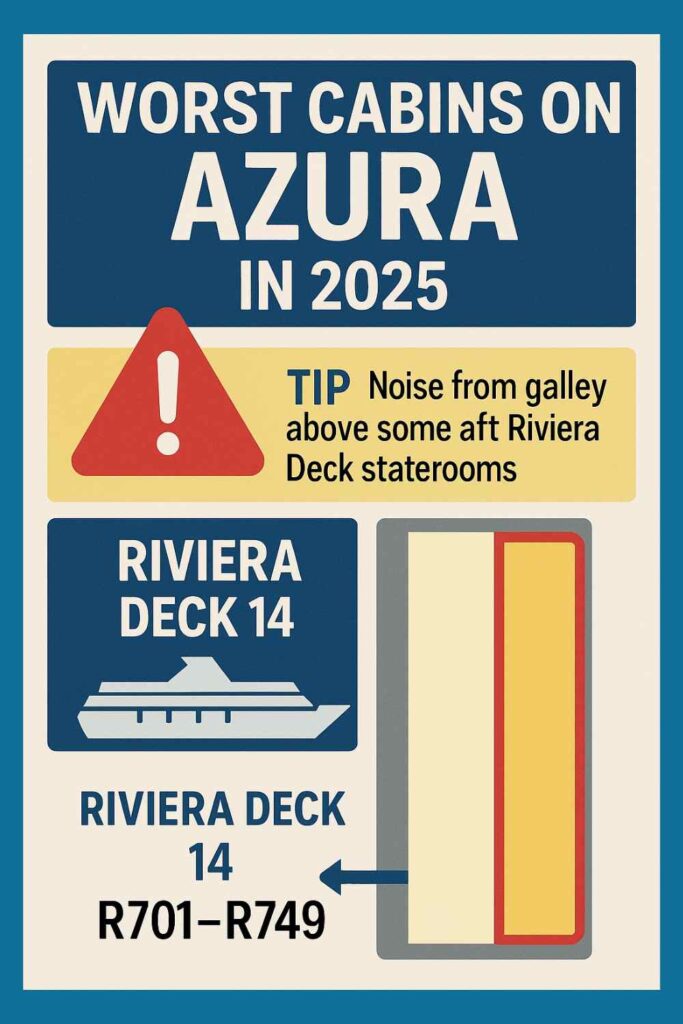
- Buffet galley shift: the dish‑washing area moved aft, placing it directly over part of Riviera Deck, so some balconies now hear 05:30 clatter.
- Expanded Playhouse Theatre tech booth: bass now bleeds sideways into forward cabins on F Deck.
- New whirlpool plumbing aft: vibration hot‑spots on D/E Decks dropped one deck lower.
- No change to lifeboat wells: obstructed windows on A Deck remain fully blocked by davits.


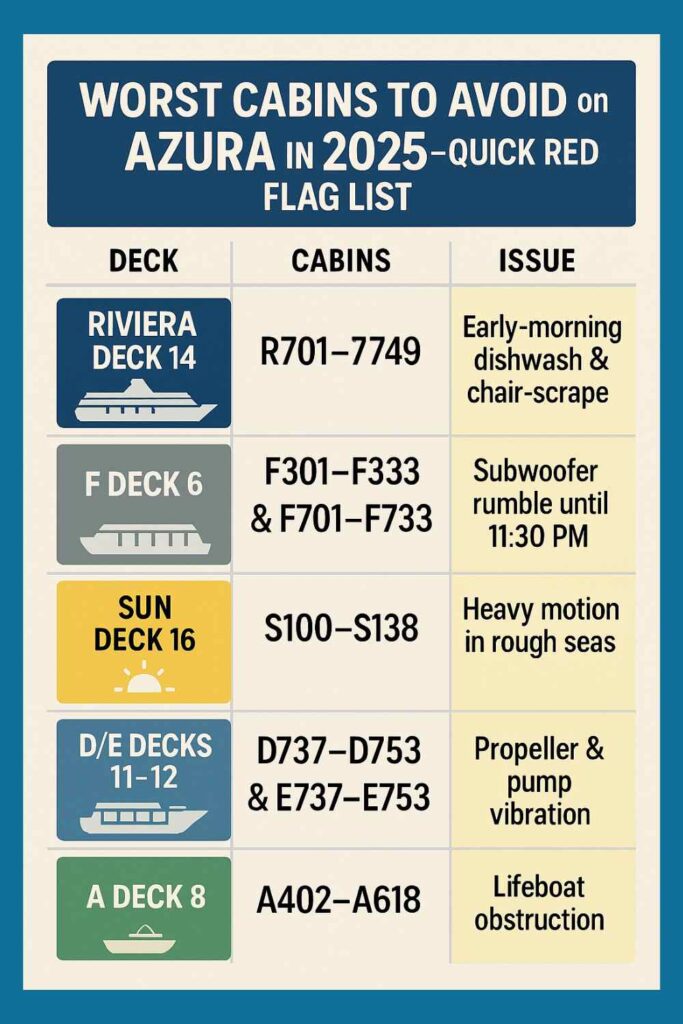
Quick‑Look “Red Flag” Cabin List
| Deck & Zone | Cabin Numbers | Main Issue | Typical Fix |
|---|---|---|---|
| Riviera Deck 14 (beneath Horizon buffet) | R701–R749 | Early‑morning dish‑wash & chair‑drag | Ear‑plugs or choose one deck below |
| F Deck 6 (above Playhouse Theatre) | F301–F333 & F701–F733 | Sub‑woofer rumble until 23:30 | Book late dining or select mid‑ship F Deck cabins |
| Sun Deck 16 (forward insides) | S100–S138 | Heavy pitching in rough seas | Opt for mid‑ship inside on Riviera Deck |
| D/E Deck 11–12 (aft suites/balconies) | D737–D753, E737–E753 | Propeller & pump vibration | Choose mid‑aft on C Deck or bring door wedges |
| A Deck 8 (lifeboat‑row outsides) | A402–A618 | View blocked by lifeboats | Treat as inside grade or move one deck up |


Under Horizon Buffet — Riviera Deck 14 (R701–R749)
Why avoid: Dishwashers and serving trolleys start rolling before sunrise; chair‑scrape repeats at meal‑turn‑over times.
Who might still like it: Shade‑seekers who prize buffet proximity and can sleep through noise.
Above Playhouse Theatre — F Deck 6 (F301–F333 & F701–F733)
Why avoid: Bass travels through bulkheads until the last show ends around 23:30.
Tip: If you’re a night owl and love theatre, the late noise won’t matter.
High‑Motion Forward Insides — Sun Deck 16 (S100–S138)
Why avoid: Most pronounced pitching on the ship; lack of a window removes horizon reference, worsening seasickness.
Tip: Invest in seasickness patches or choose a lower‑deck inside mid‑ship.
Aft Vibration Zones — D/E Decks 11–12 (D737–E753 range)
Why avoid: Early‑morning thruster maneuvers and new pool‑plant lines send shudders through aft cabins.
Tip: Bring magnetic hooks and cloths to secure rattling wardrobe doors.
Obstructed‑View Outsides — A Deck 8 (A402–A618)
Why avoid: Lifeboat structure fills the entire window view; you’ll see orange fiberglass, not ocean.
Tip: Great if you only need daylight and don’t care about scenery—priced lower than unobstructed outsides.


Azura Venue & Machinery Hotspots
1. Horizon Buffet & Open‑Air Pool Pumps (Deck 15/16)
- Noise pattern: dish‑washer clang from 05:30; chair‑drag at every meal turnover.
- Vibration: pool‑pump cycle rumbles for 3–4 minutes every hour, felt most on Riviera Deck balconies directly below.
- Smells: occasional galley‑exhaust aroma when wind blows aft.
2. Entertainment Cluster
- Playhouse Theatre (decks 7‑6‑5 void): late‑night bass, afternoon rehearsals.
- Manhattan Show Lounge (Deck 7 aft): DJ sets until 01:00 on party nights; vibration travels upward to C/B‑Deck stern.
- Beach House Galley (Deck 15 aft): fryer fans hum; audible in upper‑aft cabins during prep (16:30‑18:00).
- Self‑Service Laundries (one per deck): spin‑cycle thud and door slams; avoid cabins directly opposite the laundry icon.
3. Mooring Gear & Bow Thrusters (Forward Decks 4‑5 under Plaza)
- Anchor drop & recovery: deep metallic groan around 06:00 in tender ports, heard most in forward outsides on Plaza Deck.
- Bow thrusters: strong lateral vibration when docking; penetrates three decks up—beware forward A‑Deck cabins.
Deck‑by‑Deck Deep Dive
Sun & Sports Decks 16/17
- Motion: highest pitch and roll; forward insides (S‑prefix) feel every swell.
- Noise: kids’ splash zone and daytime music spill into corridor.
- Best bet: mid‑ships balcony on Lido Deck below for same view, less sway.
Lido & Riviera Decks 15/14
- Early prep: buffet trolleys above R‑Deck wake light sleepers before dawn.
- Deck‑chair scrape: heaviest 08:00–10:00 and 16:00–18:00; loudest under the main pool.
- Tip: Choose R‑Deck cabins beneath the spa or cabin‑only zones mid‑ships.
E & D Decks 12/11
- Engine hum & prop vibration: aft suites/balconies (D/E 737‑753) rattle at manoeuvre speed.
- Soot on wake balconies: sticky residue in humid weather; cover furniture overnight.
- Better choice: mid‑ship balconies shielded by funnel location.
C, B & A Decks 10/9/8
- Lifeboat obstructions: A‑Deck outsides stare at orange davits; some B‑Deck balconies have top‑half metal fronts.
- Crew access doors: random clank as trolleys enter service corridors—check deck plan icons before booking.
Promenade & Plaza Decks 7/5
- Theatre bass: cabins directly above Playhouse feel sub‑woofer pulses until ~23:30.
- Anchor clank & gangway ramps: Plaza forward outsides rumble when mooring gear operates; mid‑ship Plaza outsides hear gangway installation on port days.
- Quietest niche: aft‑most Promenade cabins—no public deck above, minimal through‑traffic.
Specialty Cabin Pitfalls
1. Obstructed‑Balcony “Deluxe” Cabins
- What’s blocked: steel safety screens or lifeboat davits cut the lower half of your view.
- Worth it? Fine for shade‑seekers who sit, not stand; disappointing if you dream of wake photos.
2. Inside Cabins with Inter‑Connecting Doors
- Noise bleed: thinner shared door transmits TV volume, laughter, and coughing.
- Fix: pack a draft blocker to plug the under‑door gap or request a non‑connecting inside.
3. “Secret” Forward/Outside Singles
- Pro: cheapest daylight cabin for solo travellers.
- Con: directly over mooring gear; 05:30 anchor noise is the alarm you didn’t set.
- Verdict: a bargain only if you’re an early riser or heavy sleeper.
Armed with these venue hot‑spots, deck quirks, and specialty pitfalls, you’re ready to pinpoint the calmest, cleanest view—and skip the cabins that could sink your sleep.


Motion‑Sensitivity Matrix
How Motion Works on Azura
- Pivot (Fulcrum) Point: Every ship rotates around a spot roughly one‑third of its overall length aft of the bow—mid‑ship on Azura falls just forward of the Atrium on C‑Deck. Cabins here rise and fall the least during pitching seas.
- Stabilisers: Azura’s two active‑fin stabilisers are mounted at Frame 92, intersecting C‑Deck mid‑ship. When deployed, they counteract roll but have little effect at extreme forward or aft ends.
“Green Zone” for Seasick‑Prone Travellers
| Deck | Ideal Cabin Numbers | Why It’s Better |
|---|---|---|
| C Deck 10 | C401‑C449 (port) • C402‑C450 (starboard) | Exactly above the pivot and inline with stabilisers—minimal pitch/roll plus only passenger decks above and below. |
| B Deck 9 | B425‑B465 • B426‑B466 | One deck lower = even closer to waterline for more stability; still sandwiched by passenger decks. |
| D Deck 11 (mid‑ship balconies) | D419‑D459 • D420‑D460 | Slightly higher but centre‑line cancels most motion; convenient to pools without the buffet clatter. |
Tip: If you book outside these ranges but remain mid‑ship, pack acupressure bands and ginger chews as extra insurance.
Noise‑Rating Guide
Daytime vs. Nighttime Sources
| Decibel Estimate | Typical Source | When It Peaks |
|---|---|---|
| 35–40 dB | Corridor chatter, cabin doors | 07:00 – 22:00 |
| 45–50 dB | Deck‑chair scrape (above), dishwash clank | Meal turnovers & sunrise setup |
| 55–60 dB | Theatre bass, DJ sets, anchor winch | 20:00 – 23:30 (shows); 05:30–06:30 (ports) |
| 65 dB+ | Bow thrusters during docking | 05:30 – 07:00 & arrival manoeuvres |
(60 dB is equivalent to lively conversation; 70 dB approaches vacuum‑cleaner level.)
Quiet‑Zone Cabins Light Sleepers Swear By
- Promenade‑Deck Aft (P752‑P766): No public venue above, minimal through‑traffic.
- Mid‑C‑Deck Inside (C410‑C430): Flanked by other cabins on all sides; true “library” hush.
- Forward Riviera‑Deck Balconies Below Spa (R450‑R470): Under the quieter spa treatment rooms, not the buffet.
General Cabin‑Selection Rules That Still Work in 2025
- Use the “Sandwich” Strategy
- Choose a cabin with only passenger decks above and below. This buffers you from pool‑deck scrape overhead and theatre bass below. On Azura that’s typically B, C, and mid‑D decks.
- Avoid Service Areas & Crew Stairwells
- Laundry Icons: if you see the little washing‑machine symbol opposite your cabin, skip it—spin‑cycles thud day and night.
- Crew Doors: narrow rectangles on the deck plan indicate pantry or steward access; expect trolley clang and door slams.
- The Guarantee‑Cabin Gamble
- When to Play: off‑season sailings where the ship won’t sell out; you may snag a free upgrade.
- When to Pay: school holidays, popular Mediterranean itineraries, or if you’re noise‑sensitive. Guarantees are filled last, often with leftover problem cabins.
- Upgrade Math: weigh difference between a sure‑thing mid‑ship cabin (£50–£100 pp) versus risking a forward Sun‑Deck inside and spending £15 on seasickness meds.
Follow this motion matrix, noise chart, and timeless cabin logic, and you’ll secure a restful hideaway—no rumble, scrape or roll to ruin your cruise. Happy choosing!
Frequently Asked Questions
1. Are Azura’s aft balconies really that noisy?
Light vibration and a low‑frequency hum crop up during docking and whenever the azipods adjust course. If you’re a light sleeper, stick to mid‑ship balconies instead.
2. Which deck is best for families with toddlers?
Mid‑ship on C Deck—close to lifts, sandwiched by passenger decks, and only one level above the kids’ splash pool on Lido.
3. Can I change cabins after embarkation?
Yes. Head to Reception before the muster drill; moves are handled first‑come, first‑served.
4. Do obstructed outsides get enough daylight?
You’ll enjoy plenty of daylight, but no view. Think of them as bright inside cabins.
5. What’s the quietest deck for inside cabins?
B Deck sits between two passenger decks, so no public venues above or below.
6. Will seasickness pills make me drowsy?
Some older antihistamines do. Try non‑drowsy meclizine or stick-on acupressure bands first.
7. Are forward cabins more scenic?
Absolutely—fantastic arrival views. Expect anchor noise and stronger pitching, though.
8. How early does the buffet start clanking?
Dishwashers fire up around 05:30, and chair‑scrape follows by 06:00.
9. Is there a fee to use laundries?
Washers and dryers are free; detergent sachets cost extra at Reception.
10. Can I hear nightclub music in my cabin?
Only if you’re directly above Manhattan Show Lounge on the aft C/B decks.
11. Which balconies have the most shade?
Riviera‑Deck balconies, tucked under the Lido overhang, stay comfortably shaded all day.
12. Do single cabins come with double beds?
They feature large twins; some can be combined into a small double on request.
13. Are connecting cabins noisier?
Yes. The shared door leaks sound. If silence is golden, avoid cabins marked with the connecting‑door symbol.
14. Can crew fix squeaky wardrobe doors?
Definitely—ask your steward for felt pads or a quick hinge tightening.
15. Are obstructed‑balcony “Deluxe” cabins worth the price?
Only if privacy beats having an unobstructed horizon view.
16. What’s the minimum age for balcony cabins?
Children under six need constant adult supervision; P&O can install extra child‑locks.
17. Do lifeboat drills disturb mid‑cruise naps?
Drills happen only on embarkation day, usually around 16:00.
18. Is mid‑ship always best for motion?
Yes—closest to the ship’s pivot and stabilisers, perfect for motion‑sensitive cruisers.
19. How loud are bow thrusters?
Inside forward outsides, peak noise reaches roughly 65 dB—about city‑traffic level.
20. What’s the risk of booking a “guarantee” cabin?
You save money but might land beneath the buffet or next to crew stairwells.
21. Does Azura provide cabin night‑lights?
No—pack a plug‑in LED or leave the bathroom door ajar for a glow.
22. Can I request a mattress topper?
Yes—ask your steward on day one; supplies are limited.
23. Are balcony dividers movable for families?
Many dividers fold back so adjacent balconies can connect—crew will do this on request.
24. How long does room‑service breakfast clang outside?
Peak tray pickup runs from 08:30 to 09:30. If you’re opposite a service pantry, expect extra clang at those times.
Booking Hacks & Pro Tips
1. Spot Hidden Issues on the Deck Plan
- Toggle every layer: zoom to see small service doors.
- Trace your ceiling: make sure the space above your cabin shows another cabin, not a shaded public venue.
- Count lifeboats: if the window icon aligns with a boat outline, expect an obstructed view.
2. Leverage Past‑Guest Upgrades
- Loyalty mailers: past cruisers often receive pre‑cruise upgrade offers at reduced rates—check emails weekly.
- Upgrade stand‑by list: add your name at the Pier Services desk; you’ll be notified if higher grades remain unsold.
3. Pack These “Silence Savers”
| Item | Why It Helps |
|---|---|
| Magnetic hooks | Hold shower curtain tight and stop clanging hangers. |
| White‑noise app | Masks corridor chatter and anchor clang. |
| Blackout clips | Seal balcony‑door curtains against sunrise slivers. |
| Door wedge | Stops wardrobe doors rattling when the ship vibrates. |
| Over‑door shoe pocket | Keeps meds and ear‑plugs handy without adding clutter. |
Final Take & Action Steps
Azura’s worst cabins fall into five traps: under the buffet, above theatres, forward insides on Sun Deck, aft vibration zones, and lifeboat‑blocked outsides.
Your best alternatives are mid‑ship balconies on C Deck, inside “sandwich” cabins on B Deck, and forward Riviera rooms beneath the spa. Ready to lock in a quiet retreat?
Book smart now and you’ll sip sail‑away cocktails knowing your stateroom is set for serene sea days—and even calmer nights.



Ellie is the founder of Ellie's Travel Tips, where she shares practical cruise tips, port guides, and step-by-step itineraries to help you plan smarter trips for less. Her checklists and packing guides turn travel daydreams into doable plans.