Titanic vs Modern Cruise Ships: Cabins, Dining, Safety & Experience
What would feel different if a Titanic passenger stepped onto a modern cruise ship? Cabins, dining, safety, entertainment, and daily life reveal more about the experience than a simple size ranking.
Titanic vs. Modern Cruise Ships: The Experience at a Glance
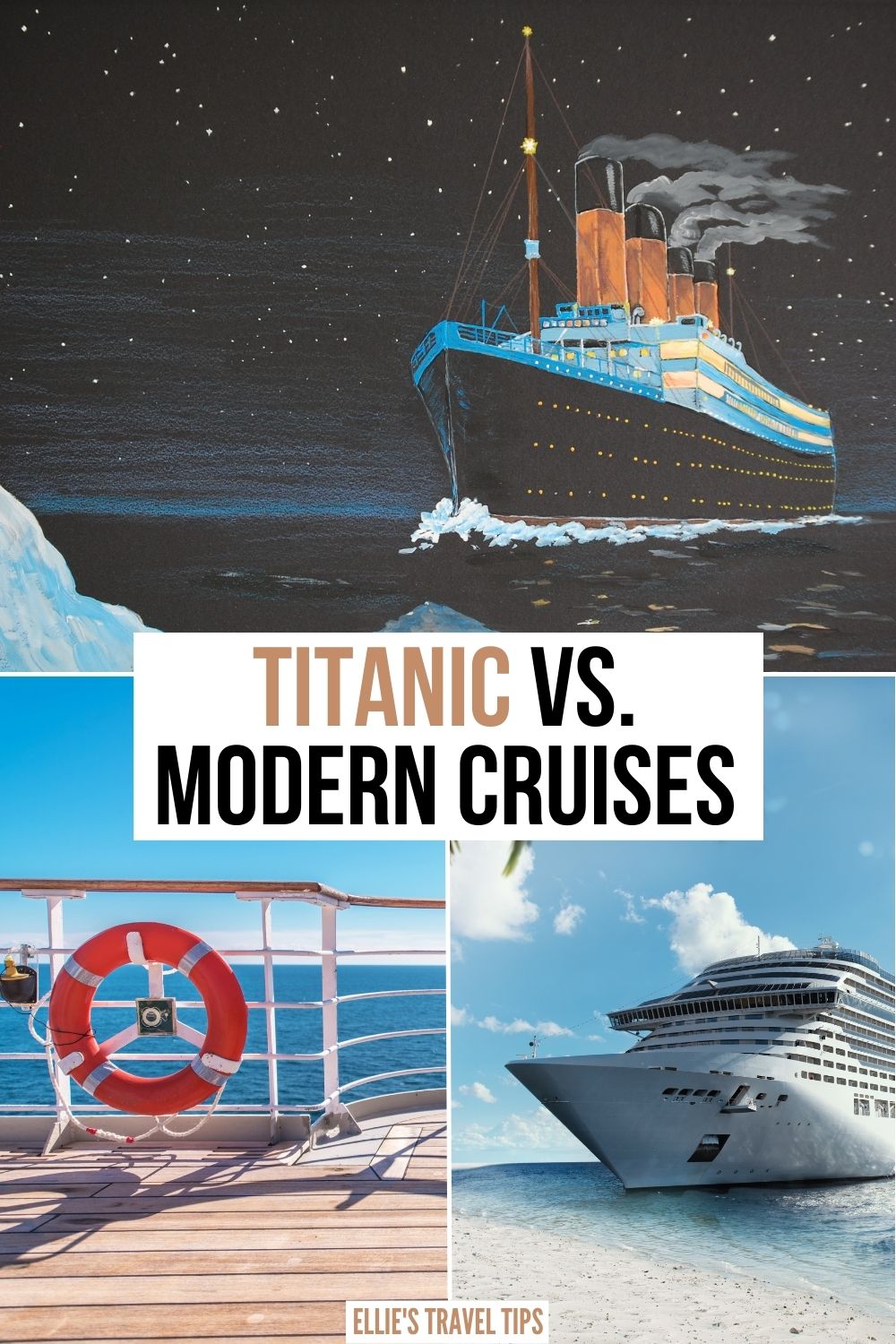
Titanic was an ocean liner built to carry people across the Atlantic on a scheduled route. A modern cruise ship is primarily a vacation destination, with its itinerary, cabins, restaurants, entertainment, and ports packaged around leisure.
That difference in purpose explains much of what travelers notice. Titanic prioritized transport, class-separated accommodation, mail, cargo, and a fast Atlantic service, while a contemporary resort ship devotes enormous space to activities and public venues.
Titanic’s verified baseline
The Royal Museums Greenwich Titanic fact sheet lists a length overall of 882.75 feet, a breadth of 92.5 feet, gross registered tonnage of 46,329, and a service speed of 21 knots.
Its listed passenger capacity was 2,435 across three classes, with space for 885 crew members. Approximately 2,200 passengers and crew were actually aboard on the casualty voyage, so capacity and people aboard are not interchangeable figures.
A current comparison point
Royal Caribbean’s Icon of the Seas deck-plan page lists the ship at about 1,198 feet long, with 20 decks and 250,800 in headline tonnage. The operator’s other pages publish slightly different length and tonnage figures, so those numbers should be read as a current, rounded operator snapshot.
Capacity also needs a label. Royal Caribbean has published approximately 5,610 guests at double occupancy, 7,600 maximum guests, and about 2,350 crew on different official pages.
For the measurement-led comparison, including the conflicting operator figures, see Titanic and Icon of the Seas compared. This guide stays focused on what travelers would notice aboard.

Size: What the Numbers Really Mean
Icon is roughly 315 feet longer than Titanic using the operator’s 1,198-foot figure. Length is easy to visualize, but it does not describe the full amount of enclosed space, the width of a ship, or how many decks passengers can use.
Tonnage creates more confusion. Gross tonnage describes enclosed volume under a formula rather than weight, and Titanic’s historic gross registered tonnage was calculated under a different measurement regime from modern GT.
That means a simple claim that a modern ship is a certain number of times heavier based on tonnage would be wrong. A responsible comparison treats length, breadth or beam, tonnage, passenger capacity, and total persons aboard as separate measures.
A useful size decision rule
If you want to understand how a ship will feel, compare passenger capacity, cabin count, public-space layout, and the venues you will actually use. Length alone cannot tell you whether corridors feel crowded or whether a pool deck feels calm.
Travelers should match ship scale to the trip they actually want. Couples can start with these honeymoon cruise ideas, then decide whether intimate spaces or a feature-packed mega-ship matter more.

Cabins and Social Class
It is inaccurate to say Titanic cabins were simply smaller than today’s cabins. First-class suites, second-class rooms, and third-class accommodation differed dramatically in space, furnishings, privacy, and access to facilities.
Modern ships sell many categories too, from compact interior rooms to multi-room suites. The key difference is that contemporary categories are sold by room type and location rather than as three rigid passenger classes governing most of the voyage.
Bathrooms and private space
Many modern cabins have private bathrooms, but room size and amenities still vary. Suites can include large balconies and separate living areas, while entry-level cabins may be compact and have no exterior view.
Do not compare Titanic’s finest suite with a modern inside cabin or Titanic’s third-class berth with a modern luxury suite. Choose equivalent price and service positions before drawing a conclusion.

Dining: Formal Service vs. Broad Choice
Titanic’s dining reflected its class structure. First-class passengers had elaborate dining and social spaces, while second- and third-class travelers ate in separate facilities designed for their ticket class.
A modern cruise ship may offer a main dining room, buffet, cafes, snack counters, specialty restaurants, room service, and suite-only venues. Access is not universal because some restaurants cost extra, require reservations, restrict ages, or are limited to certain cabins.
The practical modern advantage is choice rather than a guarantee that every option is included. Before booking, check which venues are complimentary and whether your preferred dining needs require reservations.
Food access is part of the comparison
A restaurant count can exaggerate choice when several venues share hours, charge supplements, or serve a narrow menu. Travelers with allergies, dietary restrictions, or mobility needs should compare actual menus, reservation rules, and walking routes rather than rely on a headline total.
Titanic’s service also reflected the food storage, preparation, and social expectations of 1912. A fair historical comparison can admire first-class presentation while still recognizing that passengers in other classes had a different dining experience.

Titanic used steam power, wireless telegraphy, visual lookout, compasses, charts, and the navigation practices of its era. It was technologically significant for its time, which makes dismissing it as primitive misleading.
Modern passenger ships operate with electronic navigation, radar, satellite positioning, modern communications, automated monitoring, and highly developed shoreside support. Exact equipment and redundancy vary by vessel, flag, route, and applicable rules.
Technology reduces some risks and improves situational awareness, but it does not eliminate weather, human decisions, equipment failure, or operational limits. A fair comparison focuses on systems and procedures rather than claiming a modern ship is unsinkable.

Safety: The Most Important Difference
Titanic carried 20 lifeboats with total capacity for 1,178 people, far fewer than the roughly 2,200 aboard. Some boats also left without being filled to their capacity.
The disaster helped drive the first International Convention for the Safety of Life at Sea. The National Archives overview of SOLAS explains the resulting requirement for lifeboats and lifejackets for everyone aboard.
Modern safety extends beyond lifeboat seats to fire protection, communications, training, drills, evacuation arrangements, navigation, construction, and inspection. Not every modern requirement came directly from Titanic, since standards continued evolving through later conventions, amendments, investigations, and engineering practice.
What passengers should do
Attend or complete the required safety briefing and locate your assembly station. Keep essential medication and identification accessible, and follow crew instructions instead of assuming a familiar route will remain open in an emergency.

Entertainment and Daily Life
Titanic offered social rooms, promenades, music, reading spaces, dining, and selected recreational facilities, with access shaped by passenger class. The voyage itself was transportation, even when wealthy travelers experienced exceptional luxury.
A modern resort ship may have stage productions, live music, clubs, pools, youth programs, sports, spas, shops, and technology-driven attractions. The mix varies widely, so check the exact ship rather than assuming every modern vessel has a water park or ice rink.
For a trip built around onboard variety, review an exact ship profile such as this Marella Voyager guide. A destination-heavy itinerary may make a smaller entertainment program perfectly adequate.

Pools, Exercise, and Outdoor Space
Titanic had a swimming bath for first-class passengers, along with selected exercise and promenade facilities. It was not comparable to the multiple-pool decks and outdoor attractions marketed on some modern ships.
Modern does not always mean more peaceful or more available. Pool decks can be busy, attractions may have height or age rules, and some areas are restricted to adults or suite guests.

Fares Cannot Be Compared at Face Value
A 1912 ticket and a modern cruise fare bundle different services in different economies. Inflation conversion alone cannot equalize class access, transportation purpose, cabin occupancy, taxes, gratuities, drinks, dining charges, shore excursions, or travel to the port.
For a modern budget, price the complete trip rather than the advertised lead fare. Add transportation, hotel nights, insurance, gratuities, dining, beverages, activities, and excursions you expect to buy.
Compare value, not a converted ticket price
A modern fare may include accommodation, main meals, entertainment, and transport between ports, yet exclusions vary by line and package. Titanic’s ticket also represented transatlantic transportation in a world before routine commercial air travel.
The most useful question is what each traveler received at their price and social position. That produces a more honest answer than converting a first-class ticket into today’s currency and calling it equivalent to a balcony cabin.

Which Experience Would Suit You?
Titanic cannot be treated as an early version of today’s weeklong resort cruise. It belonged to an era of scheduled ocean transport, formal class divisions, limited communications, and safety rules that had not caught up with rapidly growing liners.
A modern mega-ship suits travelers who want many dining and entertainment choices in one place. A smaller modern ship can be better for travelers who prioritize quieter spaces, unusual ports, or a simpler daily schedule.
Destination and season matter as much as ship size, so check the best time to go on a cruise before choosing the vessel. Then compare the exact ship, cabin, inclusions, and itinerary that are actually available.

The Experiential Bottom Line
Modern ships are generally larger, carry more people, offer more leisure choices, and operate within far more developed safety systems. Titanic remains historically important because it combined ambitious engineering with the limits of its era.
The most accurate comparison labels every number and avoids turning either ship into a caricature. Compare purpose, measurement method, capacity basis, cabin class, included amenities, and safety context before deciding what changed.