
Norwegian Joy has excellent cabins, but the wrong location can mean pool-deck activity, theater sound, hallway traffic, or more motion than you expected. This guide shows exactly what to check before you book.
The Short Answer: Which Norwegian Joy Rooms Should You Avoid?
Avoid choosing by deck number alone. The smartest approach is to identify what sits directly above, below, beside, and across from the exact stateroom on the current deck plan.
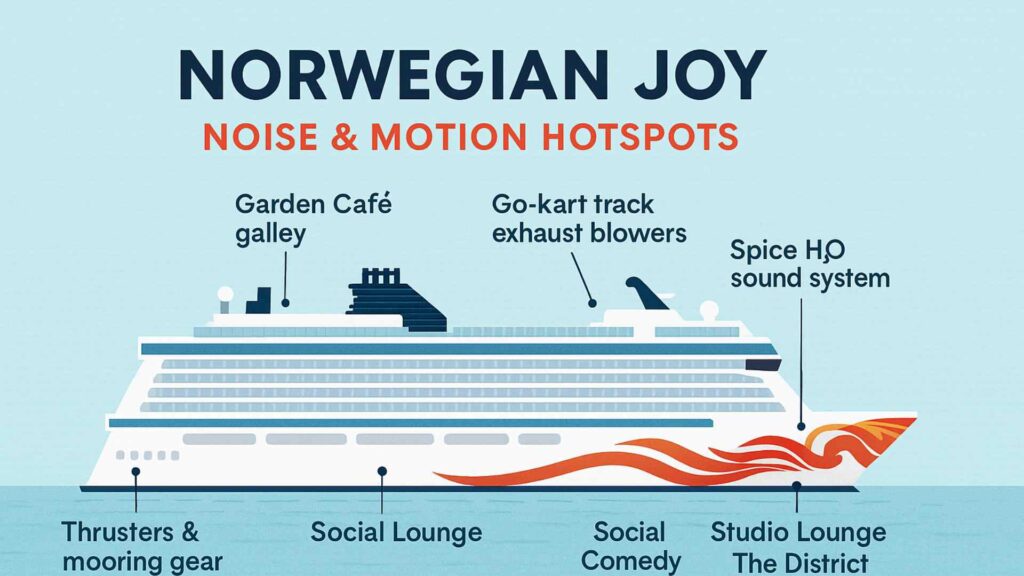
Light sleepers should be most cautious with Deck 15 cabins beneath active areas on Deck 16, forward Deck 8 cabins above the theater footprint, rooms beside crew or housekeeping doors, and any cabin directly below a busy public venue. Motion-sensitive travelers should favor a lower, more central location rather than the extreme bow or stern.
- Highest noise risk: cabins directly below pool-deck seating, the buffet, fitness spaces, or other areas that are reset early.
- Highest late-evening risk: cabins immediately above or beside entertainment venues.
- Highest motion risk: cabins far forward or far aft, especially on higher decks.
- Safest all-around pattern: a midship cabin with staterooms immediately above and below.


Start With the Current Deck Plan
Norwegian Joy was refurbished in 2024, so an old screenshot can mislead you. The work included 24 new balcony staterooms created from part of the Observation Lounge, an expanded Vibe Beach Club, a new Thermal Suite, and changes to The Haven suites.
Open NCL's current Norwegian Joy deck plans and compare your sailing's cabin assignment with the decks immediately above and below it. Do this again if NCL changes your room or accepts an upgrade bid.
The deck plan is reliable for labeled venues and cabin categories, but white or unlabeled areas are not proof of silence. They can represent crew corridors, pantries, storage, technical space, or structural areas that are not explained to guests.
1. Deck 15 Cabins Under Busy Parts of Deck 16
Deck 15 is not automatically bad, and many travelers love its quick access to the Observation Lounge. The concern is the exact overhead footprint, because Deck 16 includes active public spaces and outdoor areas.
A cabin below seating or a service route may pick up scraping, footsteps, or setup noise, especially in the morning. A cabin under a quieter section can feel completely different even when it is only a short walk away.
Traveler reports about this deck are mixed, which is useful information rather than a contradiction. Noise varies with the cabin's position, weather, passenger mix, operating schedule, and whether the balcony door is open.
- Avoid if: you are a light sleeper, nap during the day, or retire early.
- Consider if: proximity to the Observation Lounge matters more than occasional overhead activity.
- Best check: trace the walls of your cabin upward to Deck 16 instead of comparing only the printed cabin number.
The 2024 changes make this especially important for newly added forward balcony rooms. NCL's Norwegian Joy refurbishment overview confirms that part of the Observation Lounge became new staterooms, so pre-refurbishment reviews may describe a different layout.

2. Specific Norwegian Joy Cabin Numbers to Flag
The numbers below are not copied from a generic blacklist. Each one is separated into an official layout fact and a traveler-report pattern, so you can see what is established and what remains subjective.
Cabin 14511: Strongest Specific Avoid Warning for Light Sleepers
Official layout fact: Cabin 14511 is a large family interior accommodation on Deck 14, on the starboard side. The current plan shows it beneath an unlabeled or non-guest area within the broader Deck 15 Observation Lounge zone.
Traveler report: A detailed Joy report described rolling carts, impacts, and activity from the service or kitchen space overhead during both late-night and early-morning hours. Because the public plan does not label the working space precisely, the noise account is useful but the exact operational purpose should still be confirmed before booking.
Recommendation: I would avoid 14511 if anyone in the group sleeps lightly, especially because a two-bedroom family cabin is difficult to abandon after everyone has unpacked. If the space is essential, call NCL and ask what currently operates directly above the master-bedroom portion of 14511.
Cabin 8758: Forward Deck 8 Above the Theater Zone
Official layout fact: Cabin 8758 is a forward Deck 8 stateroom positioned over the Norwegian Joy Theater footprint. Nearby forward Deck 8 rooms should be checked individually because the amount of overlap changes as the corridor moves aft.
Traveler report: A recent guest in 8758 reported significant show and rehearsal sound at multiple times of day. This is one detailed room-specific account, not a shipwide measurement, but the location makes the concern credible enough that a light sleeper should choose another room when possible.
Recommendation: Avoid 8758 for early bedtimes, daytime naps, or noise sensitivity. Treat the surrounding forward Deck 8 group above the theater as a check-carefully zone rather than declaring every nearby cabin equally loud.
Cabins 15732, 15736, and 15738: Deck 15 Overhead-Activity Risk
Official layout fact: Cabin 15736 is a starboard Deck 15 Haven Family Villa in a group beneath active Deck 16 space. Cabins 15732 and 15738 sit in the same immediate section, so they share the same need for an overhead-location check even though sound may not carry identically.
Repeated traveler pattern: Discussions about 15736 and this group repeatedly focus on chairs, cleaning, passenger activity, and morning sound from above. One returning guest found the overhead noise noticeable, especially with the balcony door open, but said it eventually became background noise and did not spoil the cruise.
Recommendation: Light sleepers should avoid 15732, 15736, and 15738 when a comparable family option exists. Families who need the occupancy and value Haven access may reasonably accept the risk, particularly on cooler itineraries where outdoor-deck activity can be lower.
Cabins 15130 and 15140: Inspect, Do Not Automatically Reject
Official layout fact: Both cabins are on Deck 15 beneath the transition between Deck 16 public areas. Room-specific discussions focus on whether buffet, pool, or seating activity reaches the cabins below.
Conflicting traveler reports: Some guests in this broader Deck 15 zone mention overhead pool-deck sound, while others report that it was limited or did not disturb them. I would not call either cabin a proven no-go without stronger room-specific agreement.
Recommendation: Choose 15130 or 15140 only after tracing the exact overhead boundary on the current plan and deciding whether convenience is worth variable noise. A light sleeper with an equal alternative on a residentially buffered deck should take the alternative.
Cabin 9708: A Positive Example With a Caveat
Official layout fact: Cabin 9708 is a forward Haven suite on Deck 9 and connects with 9710. Its position involves a longer trip to the main Haven complex than suites located higher on the ship.
Traveler report: A Joy guest specifically described 9708 as a great cabin with no noise issue and liked its access to the public decks below. That positive report supports 9708 as a room to consider, but the connecting door and forward location still matter for neighbor sound and motion-sensitive travelers.
Recommendation: Consider 9708 if you want Haven space, can accept the forward position, and do not mind walking or using elevators to reach the Haven facilities. Do not treat it as a universal quiet winner if connecting-door sound or motion is your main concern.
Deck 8 can still be wonderfully convenient for dining, bars, and entertainment. The tradeoff is that convenience often brings more foot traffic and a greater chance of hearing public activity than on a residential deck.
3. Cabins Directly Below the Pool Deck, Buffet, or Fitness Areas
The risky feature is not simply being on a high deck. It is having an active hard-floor area directly over the bed and ceiling.
Pool seating may be rearranged, buffet spaces require cleaning and service, and fitness areas can create impact noise. The timing and intensity vary by sailing, so treat these as location-based risks rather than guaranteed problems.
If you normally wake at sunrise, the convenience may be worth it. If one unexpected scrape ruins your sleep, choose a room with another cabin overhead.
4. Cabins Above, Below, or Beside Nightlife
Music and crowd noise can travel through the ship's structure differently from ordinary conversation. A venue that sounds moderate inside can still send low-frequency vibration into an adjacent ceiling or wall.
Check for the theater, clubs, bars, the casino, and gathering spaces before accepting a cabin on a public-space deck. Event schedules change by itinerary, so no responsible guide can promise a fixed quiet hour.
Early sleepers should create a buffer of at least one residential deck when possible. Night owls may prefer the shorter walk and consider the same location a benefit.
5. Connecting Cabins When You Do Not Need the Connection
A connecting room is valuable for a family booking both sides, but the connecting doorway can make neighboring sound more noticeable. Voices, television, and normal cabin activity may be easier to hear than through a solid wall.
This is a possibility, not a promise that the room will be loud. If two otherwise equal cabins are available and you do not need the door, I would choose the non-connecting option.
6. Cabins Beside Elevators, Stairs, and Crew Doors
Elevator machinery is not the main concern for most nearby rooms. The more common issue is people talking while they wait, families regrouping, and passengers passing the same doorway throughout the day.
Some elevator lobbies are separated from cabin hallways by doors, and travelers often report that these locations are quieter than expected. If you need short walking distances, the convenience can easily outweigh the variable hallway noise.
Crew and housekeeping doors deserve a closer look because carts and supplies move through them. Since unlabeled spaces are not fully explained on public plans, ask NCL or your travel adviser what is opposite the cabin if the location worries you.

7. Extreme Forward Cabins for Motion-Sensitive Travelers
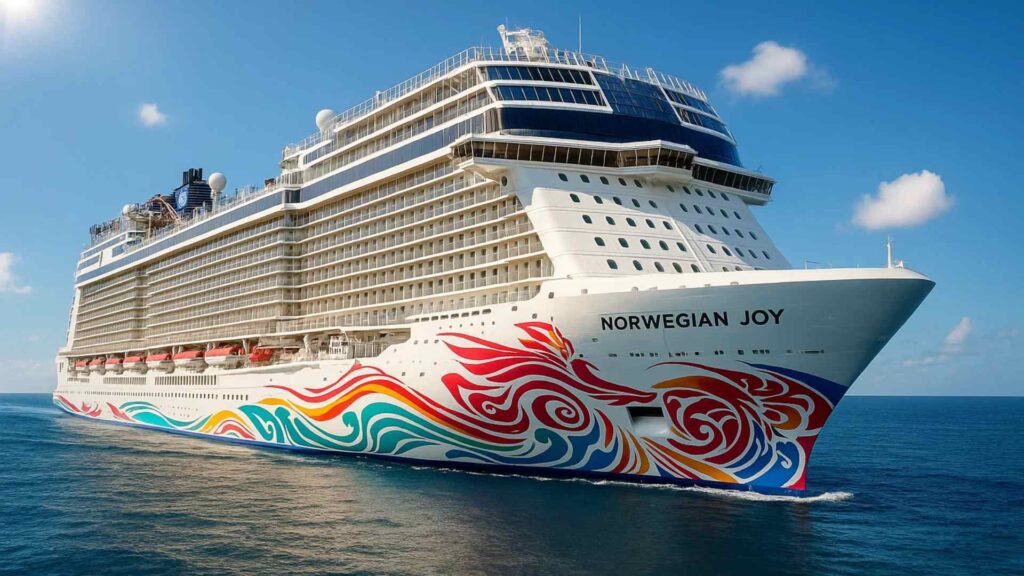
A ship's bow generally experiences more pitching than its center when seas are rough. The sensation can be more noticeable when the cabin is both high and far forward.
Forward cabins can also hear or feel normal docking activity at some ports. The timing depends on the itinerary and arrival schedule, so it is a concern for early sleepers rather than a reason everyone must avoid the bow.
If seasickness is your biggest worry, prioritize a lower deck near the ship's longitudinal center. This basic rule matters more than chasing a cabin number that one stranger called perfect.
8. Far-Aft and Aft-Facing Cabins
Aft-facing balconies have loyal fans because of their wake views and greater sense of privacy. They can also involve more vibration during certain maneuvers, a longer walk to forward venues, and occasional reports of residue on exposed balcony surfaces.
Those reports vary widely by sailing and conditions, so I would not label the entire stern a no-go zone. Choose aft for the view, but choose midship if predictable motion and short walks matter more.
9. Guarantee Cabins When Location Matters
A guarantee fare can save money, but it usually reduces your control over the exact room assignment. That is a poor match for someone who is highly sensitive to noise, motion, walking distance, or an obstructed outlook.
Read the fare and category terms before paying because assignment and change options can differ. If cabin location could determine whether you enjoy the cruise, selecting a specific room is often worth more than a modest discount.
10. Accessible Cabins You Do Not Actually Need
Accessible staterooms are designed for guests with disability-related needs and should not be treated as a secret upgrade strategy. Their layouts can also differ from standard cabins in ways that may not suit every traveler.
If accessibility is essential, confirm the exact features rather than assuming every accessible room has identical equipment. NCL's accessible cruising guidance is the appropriate starting point for arrangements and current policies.
The Best Norwegian Joy Cabin Locations
For the broadest appeal, look for a midship room on a residential deck with cabins above and below. Decks 10 through 14 contain many options that fit this pattern, but you still need to inspect the exact location.
Deck 13 is often attractive because much of it is buffered by other staterooms. Decks 10 and 11 can also work well for travelers who want easier stair access to lower public decks without sleeping directly beside them.
- Best for light sleepers: a non-connecting cabin mid-corridor with cabins above, below, and across.
- Best for motion sensitivity: a lower, central cabin near the ship's midpoint.
- Best for Observation Lounge fans: a nearby room whose overhead footprint is checked carefully.
- Best for nightlife: a convenient lower-deck cabin when late evening sound is not a concern.
- Best for families: connecting rooms when both sides are booked together, or a family category selected for the correct occupancy.
If you are comparing ships, my broader guide to cruise cabins to avoid explains the same location traps across most cruise lines. You can also compare Joy with the closely related Norwegian Encore cabin guide, but never assume that venue layouts match perfectly.

How to Check a Norwegian Joy Cabin in Five Minutes
- Find the exact cabin. Confirm the deck, side of the ship, forward or aft position, category, occupancy, and whether it connects.
- Inspect the deck above. Look for pools, restaurants, service areas, fitness spaces, and outdoor seating directly overhead.
- Inspect the deck below. Look for theaters, clubs, bars, restaurants, and other venues that operate when you expect to sleep.
- Inspect the same deck. Note elevator lobbies, stairs, crew doors, laundries if shown, and entrances to public spaces.
- Check the cabin legend. Confirm connecting doors, accessible design, bed orientation when available, occupancy, and any category-specific view note.
- Search the exact number. Treat a single review as one data point and look for repeated, recent reports from the same ship.
- Call before paying. Ask what is directly above, below, and opposite the room, then record the answer in your booking notes.
The biggest mistake is searching only for a list of forbidden cabin numbers. Venue layouts change, reports conflict, and a room that bothers a light sleeper may feel perfectly comfortable to someone else.
How to Interpret Traveler Reviews
Forum and social-media reports are valuable for spotting patterns, but they are not controlled tests. Weather, itinerary, passenger mix, show schedules, maintenance, and personal sensitivity all change what a guest experiences.
I give the most weight to recent reports that name the ship, exact cabin, sailing date, time of day, and type of disturbance. I give less weight to copied cabin lists, exact sound claims without context, or reviews that confuse Norwegian Joy with a sister ship.
When reports disagree, the correct conclusion is usually that the risk is variable. Do not turn a possible disturbance into a guaranteed promise of either silence or noise.
Norwegian Joy Cabin Myths to Ignore
“Every Deck 15 cabin is loud”
False. The overhead space changes along the deck, and some guests report quiet stays while others notice morning or daytime activity.
“Every aft cabin has serious soot or vibration”
False. Aft experiences vary, and many guests intentionally book these rooms for the wake view.
“A room near an elevator will hear the elevator all night”
Usually the meaningful risk is passenger conversation and traffic, not a constant mechanical sound. Hallway doors and the cabin's exact position can make a large difference.
“A higher deck always means a better cabin”
Higher decks offer convenient access and broad views, but they can also increase motion and put you closer to busy outdoor areas. Location quality depends on your priorities, not the largest deck number.
Frequently Asked Questions
What is the quietest deck on Norwegian Joy?
No entire deck is guaranteed to be quiet. A midship cabin buffered by staterooms above and below, away from elevators and crew access, is the strongest general choice.
Is Deck 15 bad on Norwegian Joy?
No, but it requires a careful overhead check. The location is convenient for the Observation Lounge, while certain areas may receive activity from Deck 16.
Are the new Deck 15 balcony cabins a good choice?
They can be, especially for travelers who value the forward location and Observation Lounge access. Use the post-refurbishment plan and examine the exact space above rather than relying on reviews from before 2024.
Which Norwegian Joy cabins feel the least motion?
Cabins lower and closer to the middle of the ship generally minimize motion compared with high cabins at the bow or stern. Sea conditions still matter, so no room eliminates movement.
Should I avoid an aft balcony?
Not if the wake view is a priority and you tolerate more variable motion or vibration. Choose midship instead if predictability, short walks, or motion control matters more.
Are Studio cabins noisy?
They are not inherently noisy, though cabins near a lounge entrance or busy corridor can receive more traffic. A Studio can still be an excellent solo choice when its exact position fits your sleep habits.
Can I change cabins after assignment?
Changes depend on the fare, inventory, booking channel, and timing. Ask before sailing because a sold-out ship may leave no practical alternatives onboard.
Should I use a sister ship's cabin review?
Use it only for general design clues. Norwegian Joy has its own refurbishment history and venue arrangement, so verify every conclusion against Joy's current plan.
My Booking Checklist
- I checked the current deck plan, not an old image from search results.
- I inspected the spaces above, below, beside, and across from the room.
- I confirmed whether the cabin connects to another room.
- I matched the location to my sensitivity to noise, motion, and walking.
- I understand the tradeoff if I chose a guarantee category.
- I saved a screenshot of the selected cabin and category before payment.
For the rest of your planning, these cruise tips and tricks cover the practical details that are easy to forget. If you are still deciding whether the line fits you, read my guide to the reasons travelers choose Norwegian Cruise Line.
Final Recommendation
For the safest Norwegian Joy choice, book a midship, non-connecting cabin with staterooms above and below. Move away from that pattern only when a specific benefit, such as an aft wake view or Observation Lounge access, matters more to you.
I would never reject a cabin based on deck number alone. I would reject it when the current plan shows an avoidable conflict with the way I actually sleep, move around the ship, and use the room.


Ellie is the founder of Ellie's Travel Tips, where she shares practical cruise tips, port guides, and step-by-step itineraries to help you plan smarter trips for less. Her checklists and packing guides turn travel daydreams into doable plans.